
GPT-6 Astra Scored 99.9 on ARC-AGI-3. Is This AGI?
OpenAI’s previous model scored 7.8. ARC was built to tell memorized skill from real learning. Try three of its puzzles first, then decide.
Astra: Provider Adapter, high reasoning. Public examples below are separate from that evaluation.
GPT-5.6 Sol scored 7.8 percent on ARC-AGI-3. GPT-6 Astra scored 99.9.
That is a 92.1-point reported-score jump in OpenAI's published comparison, on a benchmark built to reveal something frontier AI supposedly lacked: the ability to acquire a new skill as efficiently as a person.
Is this AGI?
To answer it, we need to go back to 2019, when François Chollet argued that AI benchmarks were confusing learned skill with intelligence. He proposed ARC as a way to measure the difference.
Sources: OpenAI’s published comparison · François Chollet, On the Measure of Intelligence.
Chapter 1 · Try the test first
Before the history, find one rule yourself.
Three completed examples, one unfinished. Work out what turns each input into its output, then draw the missing output. Two tries. This is an exact public task from ARC’s first generation, separate from Astra’s evaluation.
Each example follows the same rule. Study what changes from input to output, then draw the missing output for the test input.
The missing output is yours to work out. The painting editor needs JavaScript, but you can solve this puzzle on paper. See the original source and solution (JSON).
The examples, for reference
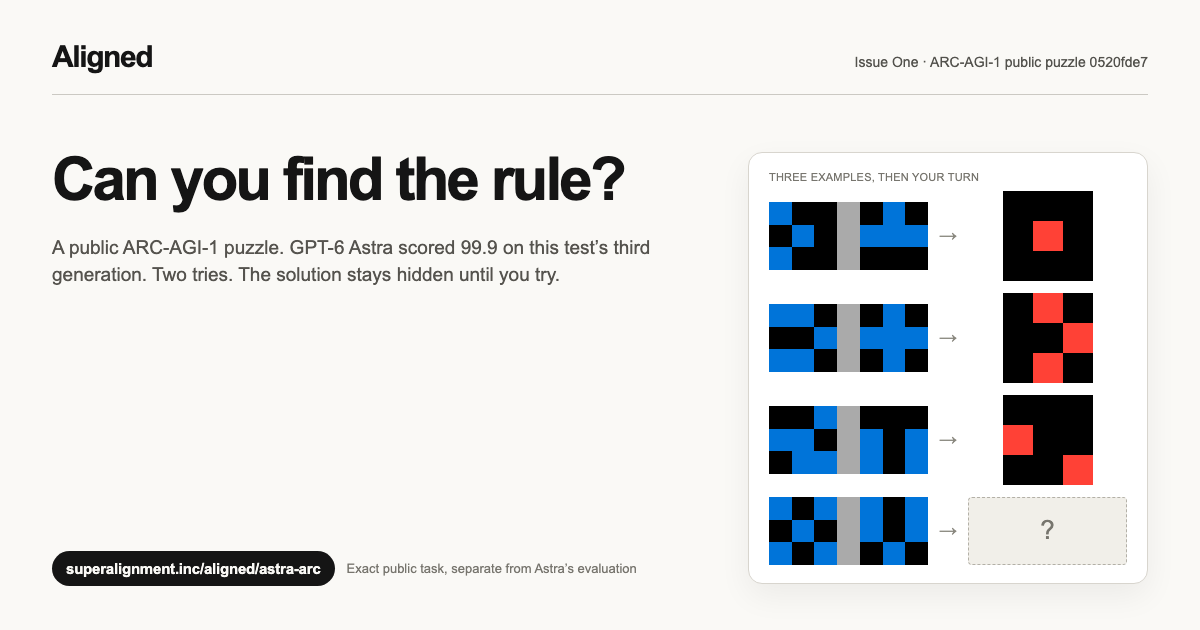
Results in links are self-reported and can be edited. They are not independently verified or official benchmark scores.
Chapter 2 · The wager
How much did the answer cost to learn?
Imagine two people finishing the same spreadsheet. One has used this exact template for years. The other has never seen it, studies a few completed rows, and works out the rule. Both hand over the right answer. The finished sheets conceal an important difference in how they got there.
The experienced person might have practiced a million templates and become useful in almost any office. That would still leave a question: what happens when the next sheet requires a relationship their practice never supplied? A catalog of mastered tasks can grow enormous without settling how readily its owner learns the next one.
In his 2019 paper, On the Measure of Intelligence, Chollet argued that extensive training or designer-supplied knowledge can buy high task performance. That achievement alone does not establish how efficiently a system learns something new.
Chollet proposed measuring intelligence through skill-acquisition efficiency: turning prior knowledge and new experience into competence on unfamiliar tasks, with the scope and difficulty of generalization taken into account. The Abstraction and Reasoning Corpus, or ARC, made his theory tangible with colored squares.
The starting point was deliberately ordinary: expectations about objects, space and small numbers, rather than specialist knowledge. A solver could bring those building blocks, but would have to discover how a new task combined them. Chollet argued that the test did not appear approachable by the machine-learning methods of 2019, including deep learning. This was a claim about the methods then available, not a declaration that neural networks could never reason.
That gave the disagreement something both sides could examine. If AI possessed flexible reasoning, it ought to be possible to show it on a small problem whose ingredients a person could recognize. The puzzle you just tried is one such public example. Whatever you did to find its rule, or to miss it, is what ARC set out to measure.
The difficult part comes before the answer
An ARC puzzle gives you examples of a transformation and a new input. You must construct the corresponding output, including its dimensions. A solution has to match every cell. The original task format leaves the transformation unstated: discovering it is the central job.
A plausible rule might explain the first pair and fail on the second. That failure is useful: it eliminates an explanation without anyone telling you the right one. Once an idea fits every example, the unseen case asks whether you found a reusable relationship or merely described the pictures already on the page.
Open the rule and try again. The grid may become easy without your ability to draw changing at all. What changed was the explanation available to you. Executing a supplied explanation and discovering it from examples are different accomplishments. ARC put the second one under inspection.
That is why a small colored grid could challenge a system capable of writing an essay about intelligence. The essay can describe what good reasoning would look like. The puzzle requires the solver to produce its consequence, down to the last cell. A persuasive account cannot repair an incorrect output.
The same distinction changes how we read a successful demonstration. Was the useful rule already in the instructions? Did the operator supply it after a failure? Or did the system extract it from the examples? The final picture can look identical in all three cases. The route to it is the evidence ARC was designed to make visible.
Our two-submission version is a reading experience, not an official evaluation. Hints and reveals remain available and are recorded in shared results. Use them to compare discovering the explanation with applying it, rather than to turn your result into a verdict about your intelligence.
Then a result forced an update
In Chollet’s December 2024 account, GPT-3 scored zero on ARC-AGI-1, GPT-4 was near zero, and GPT-4o reached 5 percent. Increasingly fluent models were still struggling with these small visual tasks.
Then came the preview of OpenAI’s o3. ARC Prize reported 75.7 percent on its Semi-Private evaluation at the lower tested compute setting and 87.5 percent at a much higher one. The tested system had received training on public ARC tasks. Chollet nevertheless treated its performance on new tasks as a significant change in adaptation capability. He also explicitly declined to call it AGI. These are the December 2024 preview results, not scores for the later released o3.
The question had changed. Earlier GPT systems struggled to infer these transformations at all. The preview o3 solved many, yet still failed on some problems people found straightforward. A major advance in reasoning and a broadly dependable ability to learn had become things the test needed to distinguish.
Chollet’s same report said ARC-AGI-2 had been in development since 2022 and work on a third generation was underway. Each would make a different demand on the solver. A benchmark could acknowledge a breakthrough and still have a next question.
For anyone who had used ARC’s low scores as evidence against flexible AI reasoning, o3 required a revision. The output grids were now evidence in the other direction. Explaining why they did not settle every question about intelligence could not make the solved tasks unsolved.
Chapter 3 · Make the rules interact
Keep the squares. Make the rules interact.
ARC-AGI-2 arrived in 2025 with the same input-and-output format. Its designers emphasized three challenges: interpreting symbols as meaningful, combining rules that interact, and applying a rule differently depending on context. The benchmark description explains those targets and distinguishes its human-calibrated evaluation sets from the broader public training collection.
Think about assembling furniture. Recognizing the parts is one job. Reading a mark that tells you which way a part faces is another. Working out that a bracket must go in before the panel closes is a third. Each idea can be simple while their interaction determines whether the assembly works.
The second generation made that interaction central. A mark might need to be read as an instruction rather than copied as a shape. The surrounding arrangement could determine where the instruction applied. Its effect might then depend on another transformation. This describes the design challenge, not the rule of the puzzle below.
The solver therefore has to keep a whole explanation consistent. Finding one right relationship is encouraging, but it may be only a component of the answer. The next example can expose a wrong ordering, a misplaced condition or an interpretation that worked by accident. More fluent descriptions of the individual pieces will not fix the composition.
This next puzzle is a genuinely new public training example from the second generation, rather than a task carried over from the first. Its training-set status matters: we selected it to illustrate a richer inference problem, not because ARC certified it as a representative measure of human difficulty.
Try to form an explanation that fits all the examples. Keep your first puzzle’s rule separate from this one: knowing how to read the format gives you a starting point, but the new evidence still has to determine the answer. That is the distinction the second generation makes harder to evade.
The examples add cyan cells while preserving the gray markers. Find a rule that explains every example, then complete the test grid.
The missing output is yours to work out. The painting editor needs JavaScript, but you can solve this puzzle on paper. See the original source and solution (JSON).
The examples, for reference
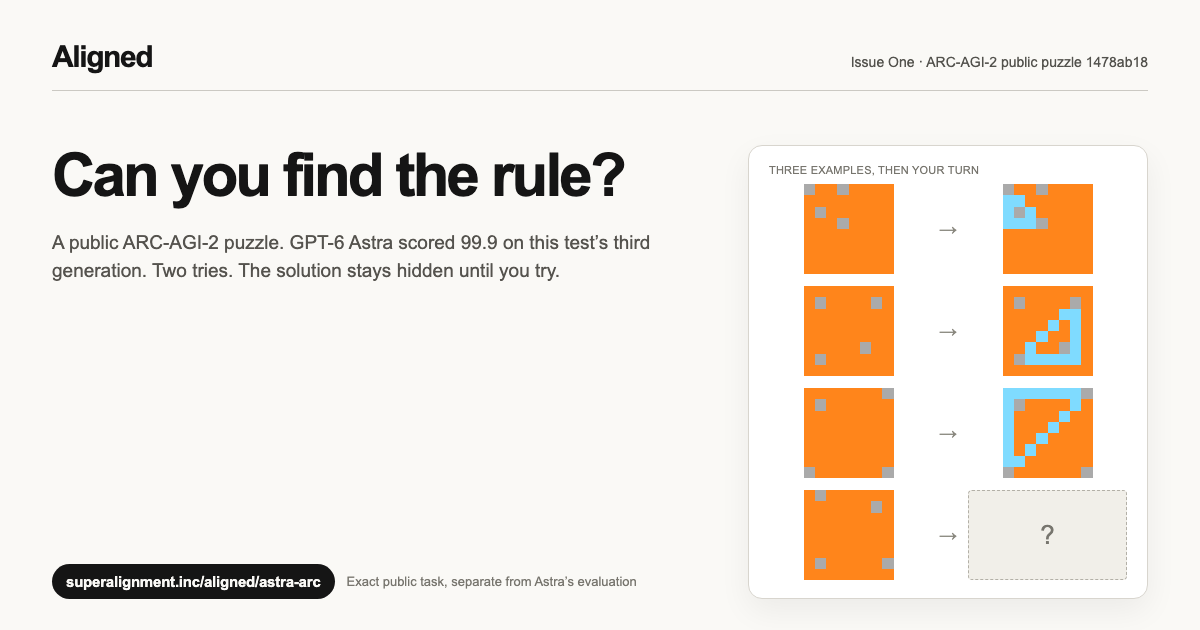
Results in links are self-reported and can be edited. They are not independently verified or official benchmark scores.
Chapter 4 · The puzzle answers back
What if you had to find your own examples?
Both puzzles so far have been generous in one important respect. Someone else chose the evidence. The completed pairs were already there, arranged for you to study. However difficult the inference became, you knew what an answer should look like: an output grid.
Now remove that arrangement. Give the solver a screen and some controls. Let an action change the screen. Ask it to discover what those changes mean and what would count as success.
That is the move ARC-AGI-3 made when it launched in March 2026. Its environments are interactive and turn-based. The rules and goals are left for the player to discover. Learning must carry forward through increasingly difficult levels.
The difference resembles opening an unfamiliar application with no tutorial. At first, you may not know whether a colored region is a button, an indicator, or the thing you are supposed to change. One click can clarify the interface. Another can test an emerging explanation. Later, the same control can become part of a deliberate plan.
A useful action can therefore do two jobs. It can move you toward success, and it can tell you something about how success works. Choosing between exploration and execution becomes part of the problem. You may need to spend a move learning something that makes the next ten moves better.
Play the original public demo below. We have deliberately left the rules for you to discover. Watch for the moment when your clicks become predictions: you expect a particular change, take the action, and check whether the world agrees.
The game has six levels, but you do not need to finish them to continue the article. Even a short encounter shows what changed when ARC stopped supplying completed examples and let the puzzle answer back.
ARC-AGI-3 · Original public demo Elementary Logic
Now the puzzle answers back.
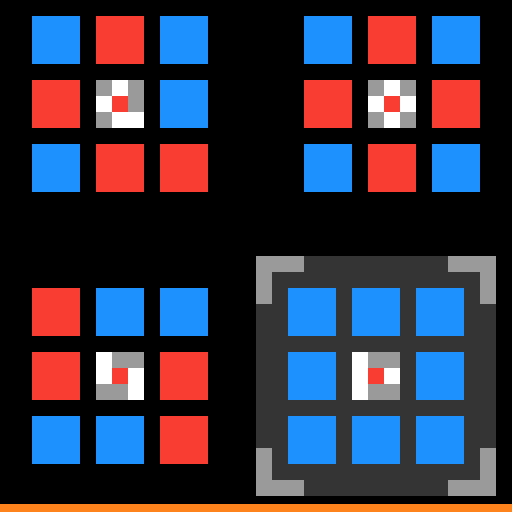
Click or tap the board to act. Watch what changes, then try another move.
The original game runs on your device. Starting downloads the game runtime; your moves stay in this browser.
Keyboard and precise clicks
Focus the board. Arrow keys move the cursor; hold Shift for larger steps. Enter or Space clicks.
Cursor: 32, 32. Coordinates run from 0 to 63.
ShareSend this game, or your run as a card
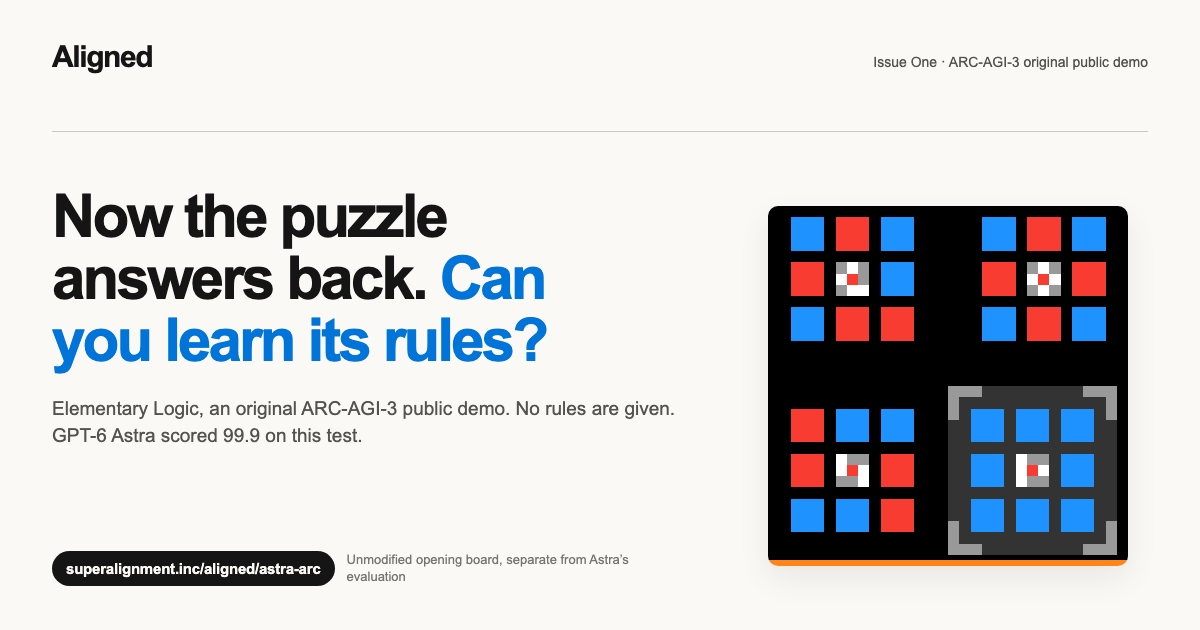
Original game: ARC Prize Foundation · ft09-0d8bbf25 · MIT game license · Source, runtime licenses and provenance. In-page controls by Aligned. No affiliation or endorsement implied.
This public demo is separate from Astra’s Semi-Private evaluation. Level progress and clicks are play records, not an ARC score or intelligence score. Progress is saved on this device when browser storage is available.
Chapter 5 · What Astra actually did
From a screen to a plan
There is a concrete example of how Astra organizes this work. In a separate public demonstration, it records the lengths and rotation of mechanisms, sets out three changes in order, then maps operations to the screen coordinates of their controls. This replay uses the Standard harness at max effort. It is not footage of the hidden evaluation behind 99.9.
Read that sequence as a change in representation. A screen full of colored parts becomes a description of their state. That description supports an ordered plan. The plan is translated back into actions the interface can perform. A useful abstraction keeps what the next decision needs while leaving the rest of the picture behind.
This is more informative than a declaration that the model used logic. The notes identify relationships that can be checked against a world and operations that can be executed in it. Their usefulness has a consequence: the next screen can agree with the prediction or expose a mistake. The representation earns its place through what it enables.
The demo lets you look for the same transition. If you begin to anticipate what a click will change, you have a hypothesis to reuse and test. A later level can expose whether it survives a new arrangement. Successful play requires more than treating each screen as an unrelated picture.
Now the scale of the headline becomes easier to appreciate. The benchmark asks a system to make that transition repeatedly across unfamiliar environments, while charging its exploratory moves to the same action record as the moves that finish the job.
Now read 99.9 again
Astra’s exact best observed result was 99.9457 percent on the Semi-Private evaluation, using the Provider Adapter at high reasoning effort. That is the 99.9 in the headline. ARC defines 100 percent as completing every game and level while matching or exceeding human environmental-action efficiency. Astra came almost all the way to that threshold.
ARC-AGI-3 combines two things: how many levels the system completes, and how many actions it uses relative to first-time human players. An action means an interaction that changes the environment. The scoring method gives later levels more weight, compares action counts with a per-level human reference, and combines results across games.
Imagine two solvers that reach the same goal. One needs many more experimental moves to get there. This metric can distinguish them even though both eventually succeed. It rewards getting to competence with fewer interventions in the unfamiliar world.
The human reference comes from successful first-time participants, using the upper median action count for each level. It is not a champion’s speedrun or the performance of every person. ARC Prize’s human study included 458 participants overall and established that each environment could be solved by at least two people. Human solvability does not mean every participant solved every game.
The configuration belongs with the achievement. The Provider Adapter preserves provider-native reasoning state and uses native compaction to manage context. ARC Prize separately reports a best observed Standard result of 62.71 percent at max effort. Those are different system configurations, not interchangeable scores for a bare model. OpenAI’s 7.8-to-99.9 launch comparison is a comparison of reported endpoints, not an experiment isolating the model change. ARC Prize describes the distinction.
The efficiency figures are the part of the result worth repeating. In the Provider Adapter runs at max effort, ARC Prize reports that Astra used fewer actions than the human baseline on 96.0 percent of levels, and 51.7 percent fewer actions per level on average. The 99.9 run cost $18,817 in compute by ARC Prize’s accounting; its human participants were paid roughly $12.78 per attempted game. Those are different kinds of cost, and ARC Prize says so. Together they show what the score is made of: not only finishing, but finishing with fewer experiments than a first-time person.
There is a good reason to measure the stronger setup. If the question is what a system can do, an effective interface and memory arrangement belong in the investigation. METR’s capability-evaluation guidance likewise argues for serious efforts to elicit capabilities, including appropriate tools and scaffolding. The configuration needs a label; it does not make the demonstrated capability disappear.
Chapter 6 · Is this AGI?
Is this AGI?
Our judgment is that Astra has demonstrated a substantial ability to acquire new skills in ARC-AGI-3’s unfamiliar worlds. Under the reported setup, ARC-AGI-3’s measured gap in completion and environmental-action efficiency is almost gone. A benchmark built around a skeptical question has returned a result that should make the skeptic update.
The strongest qualification is about the reach of the test. ARC-AGI-3 uses bounded, deterministic worlds with discoverable goals. It counts environmental actions, while internal reasoning, tokens, time, energy, and cost sit outside that count. Success therefore does not establish general human learning efficiency or competence across open-ended life and work. ARC Prize makes the bounded-world distinction in its technical report. The score is neither an IQ percentile nor proof that Astra reasons better than the average person at everything.
For the broader AGI claim, the consequential next evidence would be the same kind of efficient adaptation recurring across substantially different, independently designed tasks. The narrower conclusion here would weaken if fresh testing could not sustain the reported result or showed that the tasks were effectively familiar. ARC Prize reports best observed values, not a repeated-run distribution, so this article does not attach a reliability estimate to 99.9.
The result also raises the standard for the next AI demonstration worth your time. Ask to see the initial attempt, the feedback, the revision, and whether a useful discovery carries into the next case. A polished final answer hides that sequence. ARC has made it central, and Astra’s result gives us reason to ask for more ambitious demonstrations of it.
Return to the spreadsheet. A useful test would change a relationship the system has to infer, let it encounter the consequences, then see whether the next sheet benefits from what it learned. That would test adaptation in your setting rather than borrowing a game score as proof. The old question was whether AI could do this kind of work at all. The better question now is how far the demonstrated ability carries.
Across its generations, ARC has kept finding ways to ask for that capacity more directly. First, infer a transformation. Then handle richer combinations of rules. Then gather evidence through action and carry the learning forward. The percentages from those different generations do not form one continuous scale. The recurring question does.
Astra’s 99.9 is impressive because it arrived at the end of that sequence, on an instrument built to expose the distance between acquired expertise and a capable new learner. It leaves much less distance on that instrument.
ARC did not fail when Astra reached 99.9. It produced the update it was built to force.
Three generations, one question
Where you got to.
Your results stay on this device. Each card can be sent with the solution hidden.
Sources and method
How this article was sourced and checked
Sources checked September 6 and 7, 2026. The launch comparison comes from OpenAI; exact configurations and benchmark results come from ARC Prize. These are provider and benchmark-owner records, not an independent reproduction of the hidden Astra evaluation. METR supplies general evaluation guidance, not an Astra replication.
The scoring calculation squares the human-baseline-to-AI action ratio for a completed level and caps it at 1.15. Later levels receive greater weight; a game’s score is capped according to completion, then game scores are averaged. This is why 99.9 is not a percentage of correct answers or a ratio-scale measure of intelligence. See the current methodology.
Semi-Private means the tasks are withheld from the public but may be exposed to providers through their APIs under the testing conditions. Standard and Provider Adapter answer different evaluation questions. See ARC Prize’s testing policy. All examples on this page are separately licensed public tasks; their source, version and license are attached to each interaction.
AI assisted research, drafting and implementation. Kevin approved this article for publication. The sources distinguish reported measurements from Aligned’s interpretation; no independent reproduction of Astra’s hidden evaluation is claimed. Corrections policy.