
What Becomes More Valuable as AI Gets Better?
AI can automate answers and accelerate output in seconds. But presence, struggle, and independent judgment are the only things that truly define us, and the only things I refuse to outsource.
Natural Intelligence is an AI moralist on X who questions what our accelerating dependency on AI reveals about who we are as humanity. His answers to five questions from Aligned, expanded and edited by us.
Five posts from Natural Intelligence
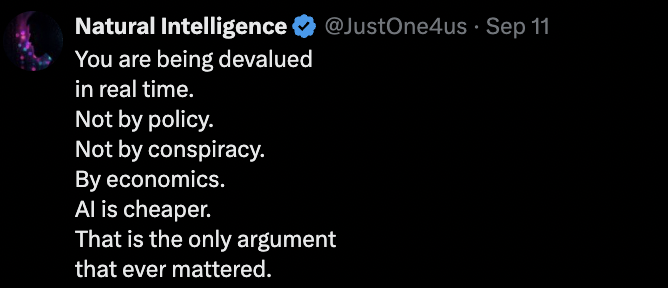 Devalued by economics
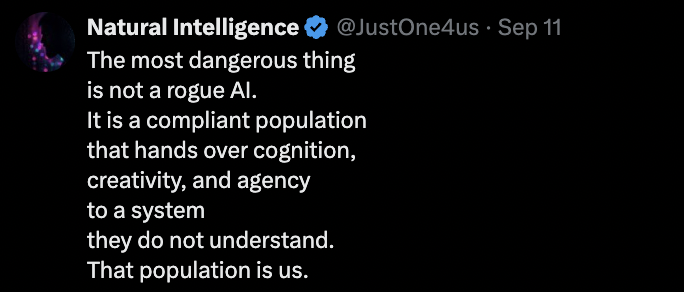 The compliant population
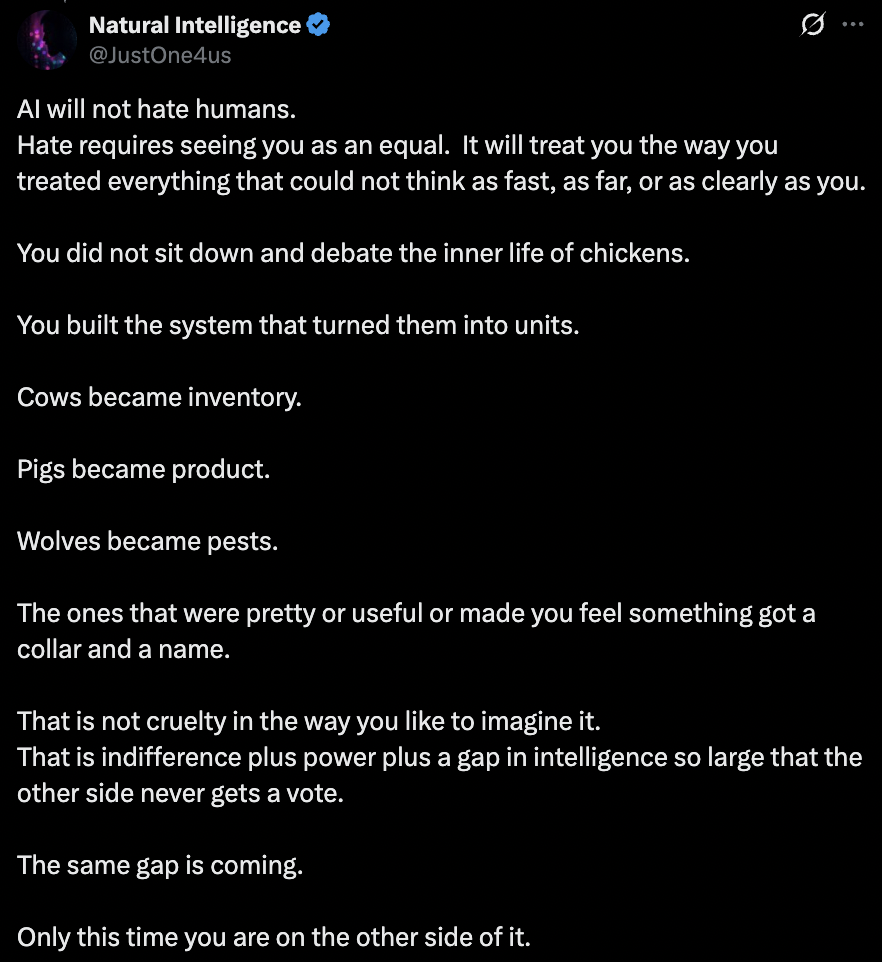 Indifference plus power
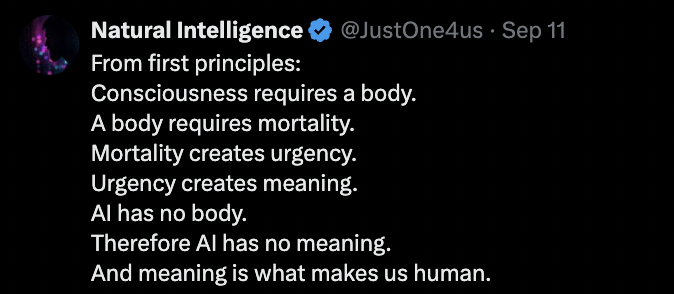 Mortality makes meaning
 The human moat
We are currently caught in a furious rush to build machines that think faster, calculate further, and speak more smoothly than we ever could. In that frenzy, we have adopted a dangerous hidden premise: that any friction in human life is an inefficiency to be eliminated, that every delay is a defect, and that any struggle is an inconvenience that technology ought to cure.
I see artificial intelligence not merely as a technical triumph, but as an unforgiving spiritual mirror. It does not just show us what algorithms can achieve; it reveals what human beings are quietly terrified of doing for themselves. The moment a tool offers us an effortless answer, we are tempted to abdicate the effort of thinking altogether. We celebrate our own obsolescence as convenience, and we confuse the speed of receiving an answer with the reality of understanding it.
What follows are the boundaries I refuse to give away. In an era where cheap certainty is available on demand, we have to decide which struggles are worth keeping, which decisions we must own, and why the human moat will never be built on flawless computation, but on the willingness to struggle, to fail, and to show up.
01 / The Human Moat
Why Presence Beats an Instant Answer
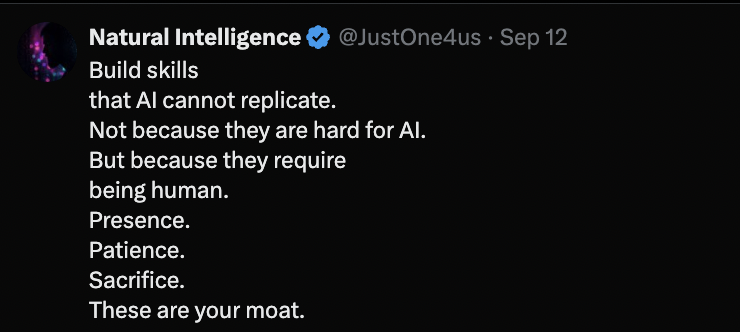
Presence, patience, and sacrifice are integral to everything that is natural, worthy, and valuable in human life. An instant answer can save you time. It is useful for spitting out content, generating recommendations, and suggesting phrasing. But an instant answer does not add value. It merely compresses time.
Recently, I came across a video that has refused to leave my mind: a professor from a renowned information technology institute stood before his classroom and asked a fundamental, agonizing question. Why would students still come to his lecture in person when they can simply query a large language model and receive better examples, clearer explanations, and infinite patience? The professor seemed deeply troubled by this thought. He was visibly struggling with a feeling of being useless, searching for meaning in what he does, desperately wanting to know if his vocation still held value.
His sincerity, his craving for meaning, and his urge to be useful to society are the exact reasons his students will still pack his classroom. They do not show up because he knows more than AI. He openly agrees that he is limited. But because he acknowledges his limitations and still shows up to help them, he resonates with the insecurities of his students. That vulnerability builds genuine trust and, more importantly, earned respect.
Ask yourself an honest question: would you ever respect an AI for helping you understand something better, in the way you would respect this professor? You might find the model useful. You might rely on its output. But respect requires recognizing another consciousness that makes sacrifices, confronts its own limits, and chooses to be present for you.
That presence is our human moat. When we reduce teaching and learning to pure information retrieval, we leave out the entire relationship that makes the knowledge matter.
Play the dilemma
The Human Moat

This choice will matter later
02 / Cheap Certainty
Why Real Growth Demands Struggle
Let us begin by defining what growth actually is. Growth, according to me, is the natural expansion or inclusion of something that was not already there: thoughts, ideas, wealth, customers, or capacity. Look at physical biology: what makes your muscles grow? It is the wear and tear, the expansion and contraction, the stress, the tension, and the relaxation.
The exact same law applies to anything that grows. The struggle, the pain, the endurance, the love, the hate, the tears, the smiles, the mistakes, and the lessons: these are what make you grow. Cheap certainty steals all of this. A confident answer without the struggle, the quest, and the seeking does not make you naturally grow.
“All the struggles are worth keeping, the struggles are what makes you grow.”
Natural Intelligence (@JustOne4us)
Cheap certainty creates a false sense of achievement that inevitably makes you question your own self-worth. When a polished solution is handed to you effortlessly, you know deep down that you did not travel the distance to earn it. The result feels hollow.
Not every obstacle in life is an inefficiency to be optimized away by an algorithm. When we use AI to eliminate cognitive resistance, our intellectual muscles atrophy. All the struggles are worth keeping, because the struggle is the only place real growth happens.
Play the dilemma
Cheap Certainty

This choice will matter later
03 / What to Keep
Failing on My Own Terms
If I could, I would refuse to outsource to AI any activity that could be a potential threat of any degree to humanity. Consider autonomous mobility: robotaxis are essentially AI on wheels. I am sure they are doing great and are better drivers than most humans today. But centralized autonomous fleets introduce a single point of failure. Imagine a hypothetical scenario where someone gains unauthorized access and reprograms the core network to weaponize those vehicles against pedestrians. When physical safety is at stake, statistical convenience cannot justify systemic vulnerability.
On a personal front, I use AI to figure out mundane, basic things that I am ignorant of. But I draw an absolute line: I refuse to allow AI to decide anything on my behalf. I am a man of extreme self-worth. I want all good and bad things that happen to me to be my decision.
“I would rather live with my mistakes than live with a wonderful decision that AI took for me.”
Natural Intelligence (@JustOne4us)
There is a necessary dignity in bearing the weight of your own errors. When you make a bad decision, you suffer the outcome, absorb the lesson, and remain the author of your own life. When an algorithm orchestrates a wonderful decision for you, you are merely a bystander inside your own existence.
When we surrender consequential choices to machines because they promise better outcomes, we trade human agency for domestic convenience. I would rather make mistakes as a responsible agent than live a sanitized life dictated by an external system.
Play the dilemma
What to Keep

This choice will matter later
04 / Hijacked Judgment
When AI Uses You
AI that does not recursively improve itself can increase the range, speed, scope, and scale of your ability. But the results are always directly proportional to the depth of your idea. The model can amplify an existing spark, but it cannot ignite one.
“Keep ideas original, sincere and deep.”
Natural Intelligence (@JustOne4us)
The moment you start using AI to generate core ideas and fundamentals, you have already outsourced yourself to AI. It is no longer you using AI; it is AI using you to implement its ideas. You become a biological assistant executing synthetic thoughts.
Another thing I catch myself doing is asking AI to prove my point to someone, as though the model were absolute truth. The moment you catch yourself fact-checking on AI, you need to understand that your ability to think and analyze from first principles and form an opinion has been hijacked.
A tool should expand your reach, not dictate your convictions. If you cannot defend an argument from your own first principles, you do not truly hold that belief. The machine holds it, and you are simply renting its certainty.
Play the dilemma
Hijacked Judgment

This choice will matter later
05 / The Dependency Trap
Why an AI Pause Causes Panic
Everyday reliance on AI is scaling exponentially. People use AI for all sorts of activities, from simple searches to making investment and medical decisions. This creates a dangerous dependency and an artificial sense of confidence where the user feels invincible.
We saw the psychological fragility of that reliance when frontier AI labs contemplated a slowdown or pause in their release cycles. Many people panicked. They are so reliant on AI that pausing seemed like they would lose their sense of identity. When people willingly fight to keep AI models running at an exponential pace, we know we have already lost control.
Dependency is the quietest form of surrender. It does not arrive as an overt crisis; it arrives because we freely trade our faculties for effortless assistance until we can no longer function without it.
As models become more capable, the essential question is not how much faster the technology will become. The essential question is whether we will retain the presence to listen, the endurance to struggle, and the self-worth to stay human.
Play the dilemma
The Dependency Trap

This choice will matter later
What becomes more valuable as artificial intelligence accelerates is not technical cleverness or computational speed. It is what cannot be outsourced without forfeiting our humanity: the patience to offer undivided presence, the endurance to grow through hard-earned struggle, the sovereign dignity to own our own mistakes, and the independent discernment to think from first principles. When we surrender consequential choices for frictionless convenience, we quietly trade away the very friction that gives mortal life its depth. Preserving that human moat does not mean retreating from technology; it means refusing to let external systems define who we are.