
The AI crisis may begin with a boom
You can learn the tools, get better at your work, and still worry about how you’ll earn a living. The AI boom has to solve that problem too.
The boom
AI investment, capability, and productivity can rise together before instability appears.
The mismatch
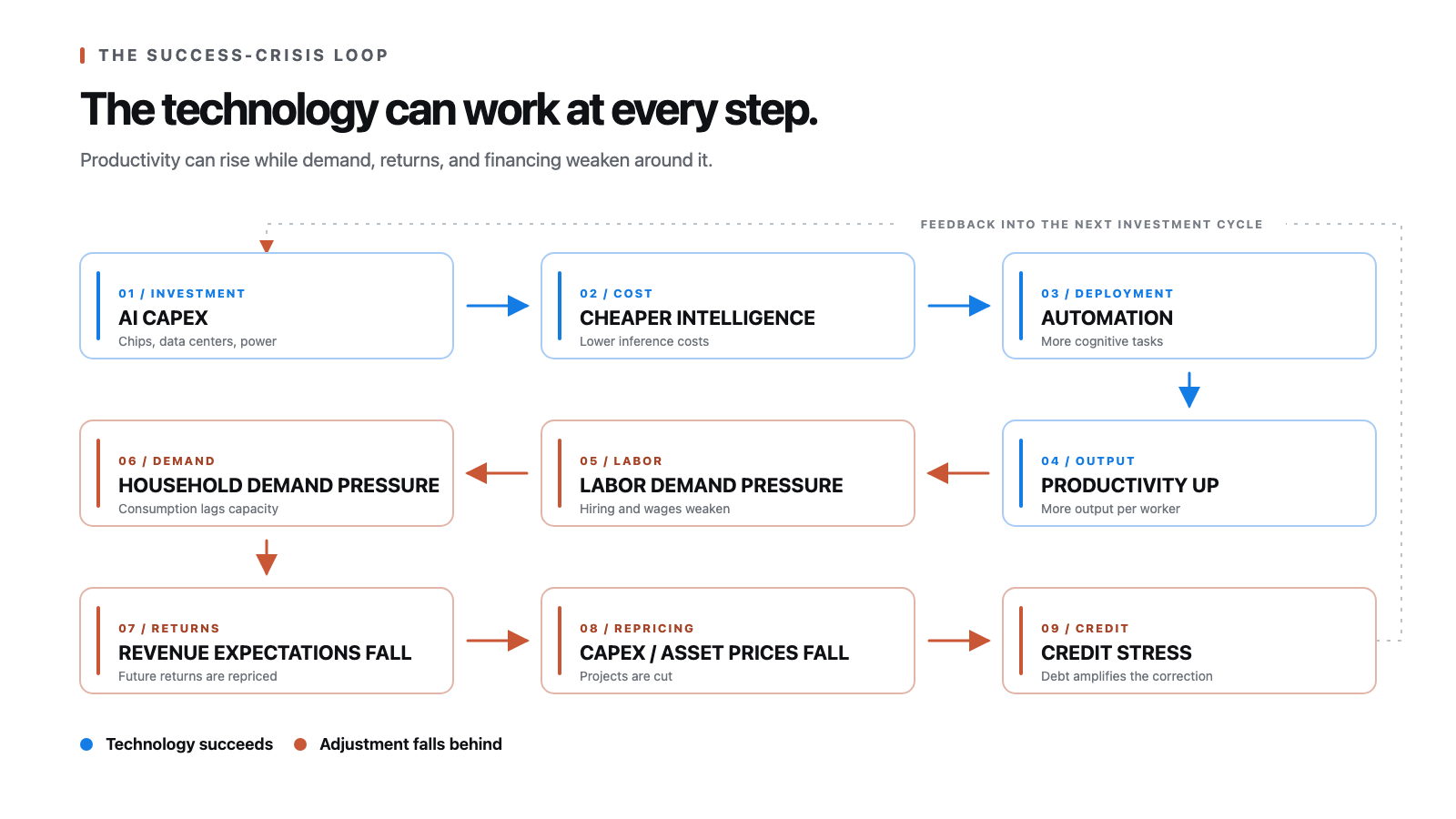
Technology can compound faster than wages, demand, infrastructure, and institutions adjust.
What to watch
The distance between capability growth and the economy's ability to distribute the gain.
Imagine spending your evenings learning AI because you don’t want to be left behind.
You get better at research, finish reports faster, and build a portfolio you’re proud of. Then you open the job listings and find fewer places looking for someone at your level.
You followed the advice. You learned the technology. What you need now is someone willing to pay for what you can do.
This is hypothetical, and learning AI is still worth doing. But it exposes something the usual advice misses: getting better at doing work and having a better chance to earn from it are not the same thing.
Meanwhile, enormous sums are being spent on the technology. In June 2026, the Bank for International Settlements projected that the five largest cloud and AI infrastructure companies would spend more than $1 trillion on AI-related capital expenditure across 2025 and 2026. That means assets such as chips, servers, and data centers. It is a two-year spending projection, not a measure of what those investments will earn. (Bank for International Settlements)
Those investments could support useful services, new businesses, and better jobs. But their success depends on what happens outside the data centers, too.
Can people find paid work as existing tasks become easier to automate? Do cheaper services leave households better off? Will enough customers keep paying to support everything being built?
That is how an AI crisis could begin during a boom: the technology improves, spending rises, and some people become less secure. The risk is a gap between technological progress and the jobs, incomes, and revenues needed to support it.
01 / AI economy
Why this is about more than tech stocks
You do not need to own shares in an AI company for the investment boom to matter.
The construction itself creates work. Buildings are assembled, equipment installed, services supplied. But some of that spending runs on borrowed money and on promises about future payments. BIS researchers describe arrangements in which a separate business develops a data center, takes on debt, and repays it from the rent that technology companies pay for computing capacity. Investment funds and banks can be involved at different points, and the financial risk depends on who owes what if the expected payments fall short. (Bank for International Settlements)
Picture a fictional project that collects $100 million in a year, spends $65 million running it, and owes $20 million in loan payments. It keeps $15 million. If receipts fall to $80 million and the loan payments stay fixed, it is $5 million short. The equipment still works perfectly. The problem is earning enough to pay the bills already promised. Credit stress is the point at which meeting those payments, or arranging affordable new financing, becomes difficult.
For ordinary people, the wider concern is what happens next: projects canceled, suppliers losing business, lenders growing cautious about financing anything else. BIS research maps those channels and stresses that the outcome depends on the particular financing arrangements. In January 2026, its researchers rated the boom's economic and financial-stability risks as moderate, while noting how much rests on high earnings expectations. (Bank for International Settlements)
There is a second source of pressure, and it is the one this article is mostly about: people struggling to earn enough to remain customers themselves.
To understand that risk, we need a better answer than “people will adapt.”
02 / AI economy
People adapted before. How?
The historical reassurance is reasonable. Machines took over work, then computers took over more of it. People continued finding things to do.
But the useful question is what made that possible.
Economist David Autor describes several effects working at once. Automation removes some tasks, makes other human contributions more valuable, and can lower prices enough to increase what customers buy. More demand can create work even as each individual product or service requires less labor. (David Autor, Journal of Economic Perspectives)
In other words, people did not adapt simply by remaining willing to work. There also had to be work worth paying them to do.
Electricity makes that distinction clear. Factories did not receive all its benefits by replacing a steam engine and leaving everything else untouched. Individual electric motors allowed machines to be rearranged around the production process. Research by economic historians Paul David and Gavin Wright describes how changes in factory layouts and work organization helped produce the gains from electrification. (Paul David and Gavin Wright)
Workers learned different responsibilities, but the workplace changed around them. The adjustment could not be completed by employees alone.
And the gains did not always arrive when people needed them. In Robert Allen’s reconstruction of British industrialization, wages adjusted for prices lagged behind rising output per worker for decades. His account shows how an economy could become more productive without workers immediately receiving a comparable improvement in living standards. (Robert Allen, Engels’ pause)
That distinction matters when the reassurance is being offered to someone with bills due next month.
An economy becoming richer over generations is not the same as a person recovering their income before their savings run out.
Computers also make the comparison with AI less simple than “machines replaced muscles; AI replaces brains.” Computers were already doing mental work, including calculations and recordkeeping. They also increased the value of some responsibilities involving interpretation, problem-solving, and judgment. (David Autor, Journal of Economic Perspectives)
The question now is which opportunities will expand around AI, and whether people whose work changes can actually reach them.
03 / AI economy
What are you supposed to retrain for?
Suppose you work in customer support and decide to move into data analysis.
You spend months learning to organize information, check calculations, and explain what the numbers mean. During that time, AI becomes useful for more of those tasks.
Your learning has not become worthless. You may be much better equipped than before. But the new qualification does not guarantee that employers need the same number of people, or that the available jobs pay enough to justify the transition.
This is a possible difficulty with AI adjustment: the destination can change while you are preparing to move toward it.
Economists Daron Acemoglu and Pascual Restrepo distinguish between automating existing tasks and creating new tasks that increase demand for people. Their framework explains why producing more does not by itself create enough new work to replace what has been removed. (Acemoglu and Restrepo, Journal of Economic Perspectives)
There is a straightforward reason the outcome could be better, too.
Suppose a tool cuts the work needed for a service in half. If the service becomes cheaper and twice as many customers buy it, the total amount of work could stay the same. If customers buy little more than before, fewer people may be needed.
We cannot tell which outcome occurs by looking only at how impressive the tool is.
Speed adds another difficulty. St. Louis Fed research found that early generative-AI adoption spread faster than personal computers and the internet at comparable points after their selected mass-market introductions. That measures people using the technology, however, not complete jobs disappearing at the same speed. (Federal Reserve Bank of St. Louis)
For someone changing careers, even a partial shift can matter. Can they afford the training? Is there time to practice? Will an employer take them on before they are fully experienced? Does the new work cover their living costs?
“Learn AI” addresses part of the problem. It does not answer those questions.
04 / AI economy
You need experience. Where do you get it?
Imagine starting your first office job.
You prepare a report. A more experienced colleague points out a weak source, catches a mistaken calculation, and asks why you chose one explanation over another. You revise it. The next report is better.
The work serves two purposes. Someone gets a useful report, and you begin learning how to produce one reliably.
Now imagine that AI produces the first version and an experienced person checks it. That may be an efficient way to finish the report. But if the beginner’s role disappears, so does one place where a beginner could have learned.
The concern is not that every repetitive task must be protected forever. It is that removing the task does not automatically replace the practice it provided.
There is evidence that finishing work and learning from it can diverge. In a randomized study reported by Anthropic, 52 programmers learned to work with an unfamiliar coding tool. Those allowed AI assistance averaged 50% on a follow-up comprehension test, compared with 67% among those working without it. The study did not find a statistically reliable speed improvement. It was a small experiment, and it measured understanding a short time afterward. (Anthropic)
For a learner, the distinction is practical: can you explain why the answer works, recognize when it is wrong, and handle a different problem tomorrow?
A finished document cannot answer that on its own.
Learning with AI could include trying an approach first, asking for explanations, checking the evidence, and getting feedback from someone experienced. That is an approach worth testing.
It also assumes someone gives you the opportunity.
Stanford researchers studying US payroll data through June 2026 found that employment among 22–25-year-olds in highly AI-exposed occupations was about 19% below where it would have been had it grown at the same pace as employment among similarly aged workers in less-exposed occupations. The difference appeared mainly through reduced hiring. The researchers do not establish how much of the gap AI caused, and they do not find widespread displacement across the economy. (Stanford Digital Economy Lab)
That is not a finding that AI eliminated 19% of young people’s jobs. It is an uneven employment pattern that needs explanation.
But it points to something a headline about layoffs can miss. For someone starting out, the problem may be a job that never opens.
05 / AI economy
Cheaper AI does not guarantee an easier life
You experience the economy through what you can earn and what that money buys.
Suppose AI makes your freelance work much faster. If you can keep your rate and find more customers, that could be a substantial improvement. If customers expect a much lower price and there is no additional work to take on, the same speed improvement may do less for your income.
The software does not decide between those outcomes.
Nor does money disappear when a business spends less on labor. Savings can become lower customer prices, higher wages for remaining employees, investment, or returns to owners. New work can appear elsewhere. The risk to household spending depends on those responses being insufficient to make up for lost income.
That is why the simple argument that fewer workers mean less spending and economic collapse is incomplete.
Consider a household whose earnings fall but whose overall living costs fall even more. It could be better off. Now consider someone whose digital subscriptions become cheaper while their income falls substantially and their other bills barely change. They could be worse off.
The relevant question is what happens to the whole budget, not the price of one AI-powered service.
If enough households suffered lasting income losses without sufficient offsets, they might cut spending. Businesses serving them could then earn less and reduce their own spending. That chain is possible. No one has shown it running yet.
The connection to AI infrastructure needs to be demonstrated too. A data center may receive payment under a long-term agreement with a technology company. We cannot assume that one household canceling a subscription immediately affects the project’s loan repayments.
To establish a broader crisis, we would have to follow those links.
For now, there are two distinct concerns: whether people can replace lost earning opportunities, and whether the infrastructure being built can earn enough to support its costs. They could reinforce each other, but neither proves the other.
06 / AI economy
There is also a way this gets better
The case for optimism deserves more than a passing mention.
AI could make knowledge and assistance available to people who previously lacked them. More importantly, there is evidence of it helping less-experienced people perform better at paid work.
A study of 5,172 customer-support agents found that AI assistance increased the number of issues resolved per hour by 15% on average. Less-experienced workers benefited more, and the researchers found evidence consistent with learning. In that setting, AI helped beginners rather than simply removing their tasks. (Brynjolfsson, Li and Raymond, Quarterly Journal of Economics)
That does not cancel the programmer experiment. The studies involved different tools, tasks, and learning conditions. Together, they suggest that how people use AI matters, not just whether they use it.
There is also evidence against treating adoption as an immediate loss of income. Anders Humlum and Emilie Vestergaard linked Danish adoption surveys to administrative records through December 2024. They found substantial changes in work without meaningful average effects on earnings or recorded hours attributable to adoption during that period. They also did not attribute early-career employment declines to firms adopting generative AI. (Humlum and Vestergaard)
Those findings do not settle what happens in every country or later period. They do show why a demonstration of AI completing a task cannot stand in for evidence of people losing their livelihoods.
The investment boom could work as well. Customers might find enough valuable uses, costs might fall, and projects might earn the money their financing requires. (Bank for International Settlements)
For ordinary people, successful adjustment would have recognizable signs: a first job that provides real experience, training that leads to paid work, earnings that stretch further, and more room to make plans without worrying that another change will put everything on hold.
Learning the tools can help. It should not have to carry the entire burden.
07 / AI economy
What GPT-6 changes, and who owns the mistake
OpenAI presents GPT-6 Astra as an advance in using computers, coding, and completing professional tasks involving several steps. Its examples include research and the production of documents, spreadsheets, and presentations. These are OpenAI’s capability claims, not independent evidence of what happens to employment or incomes. (OpenAI)
For someone outside the technology industry, the important question is less about the score on a test than what changes in everyday work.
Could it help you understand a subject that previously felt inaccessible? Could it let you take on work you were not ready for before? Could it make a service cheaper enough that more people can afford it?
Or could it make a larger part of your current role easier to perform without hiring someone to do it?
These are different possibilities surrounding the same technology.
A system helping you write a paragraph leaves you responsible for the work around it. A system that gathers the information, uses the software, checks the calculations, and assembles the result changes a larger share of the task. It also changes something quieter: who owns the mistake.
Return to the first office job. The beginner’s report had a weak source in it. The mistake was theirs, someone told them so, and the next report was better. That is what a mistake is for at the start of a career. When the system drafts and the senior checks, the mistake still gets caught. It just belongs to nobody, and nobody learns from it. The report is fine. The apprenticeship is missing.
Reliability has to be measured with that in mind: not only how often the system is wrong, but who catches it, and what they get out of catching it.
Calling the system AGI (artificial general intelligence) does not settle the economic question. We do not need agreement on that label to ask whether people are finding better opportunities as these capabilities improve.
That is the useful lesson from earlier technological change. Adaptation was not simply a test of whether humans were smart enough. It also required places to learn, demand for new work, and a way for people to benefit from the increase in what could be produced.
Go back to the person learning AI in the evening.
GPT-6 might help them understand more, make better work, and attempt things they could not have done before. Those are real possibilities worth welcoming. But the next morning, they still need an opportunity to turn that progress into a living.
The next model may help you do better work. The bigger test is whether the economy built around it helps you build a better life.