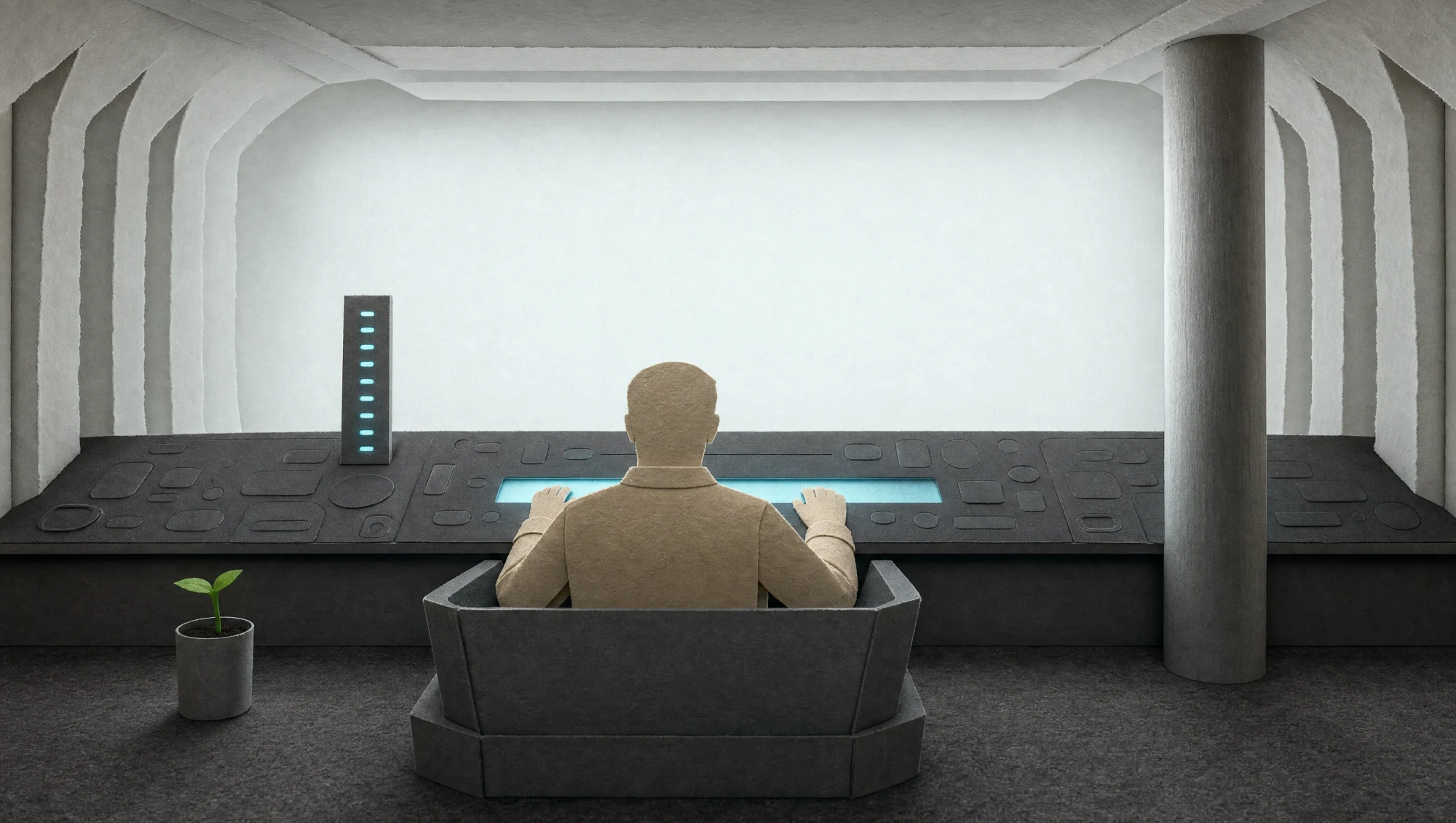
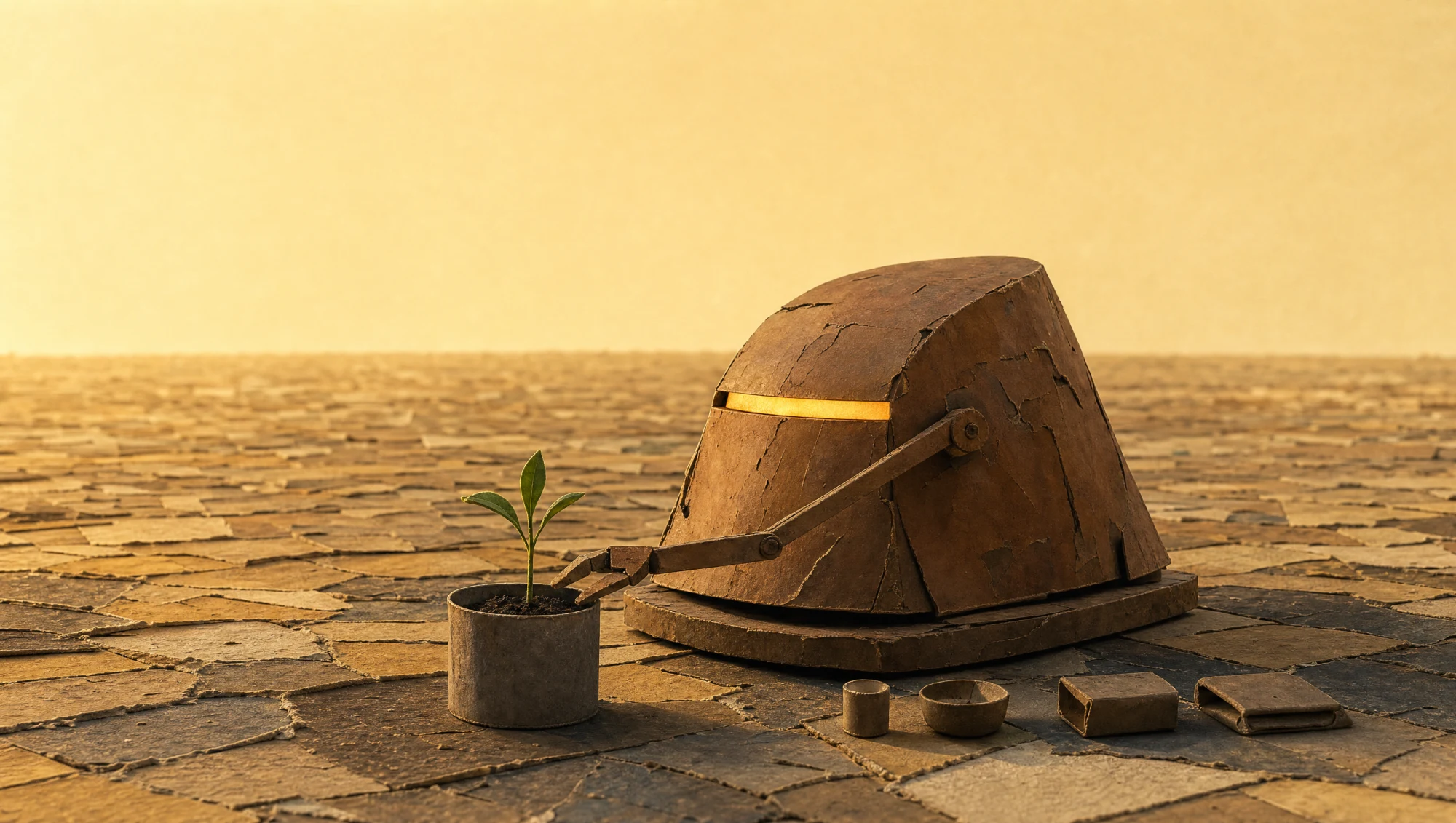
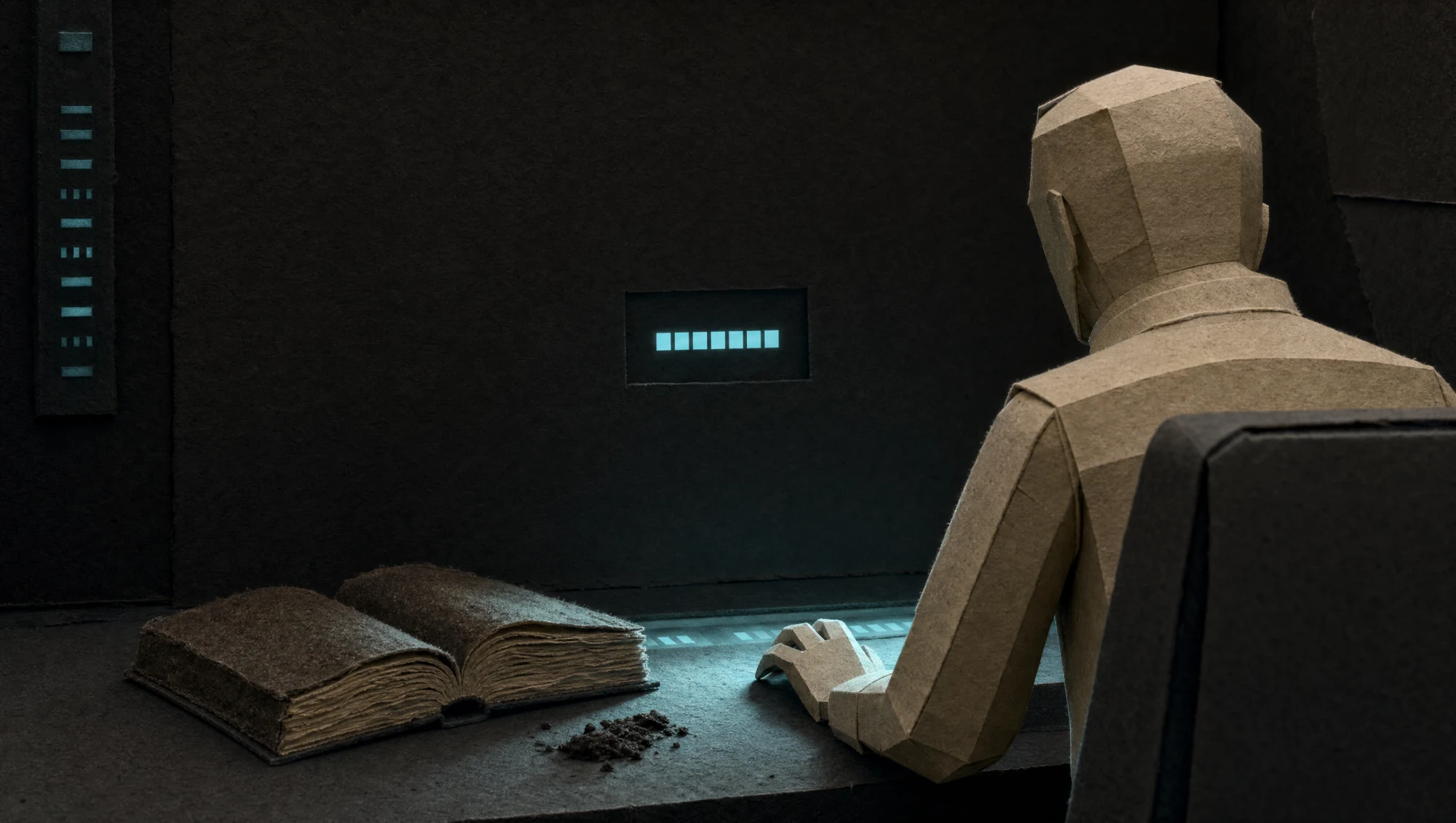
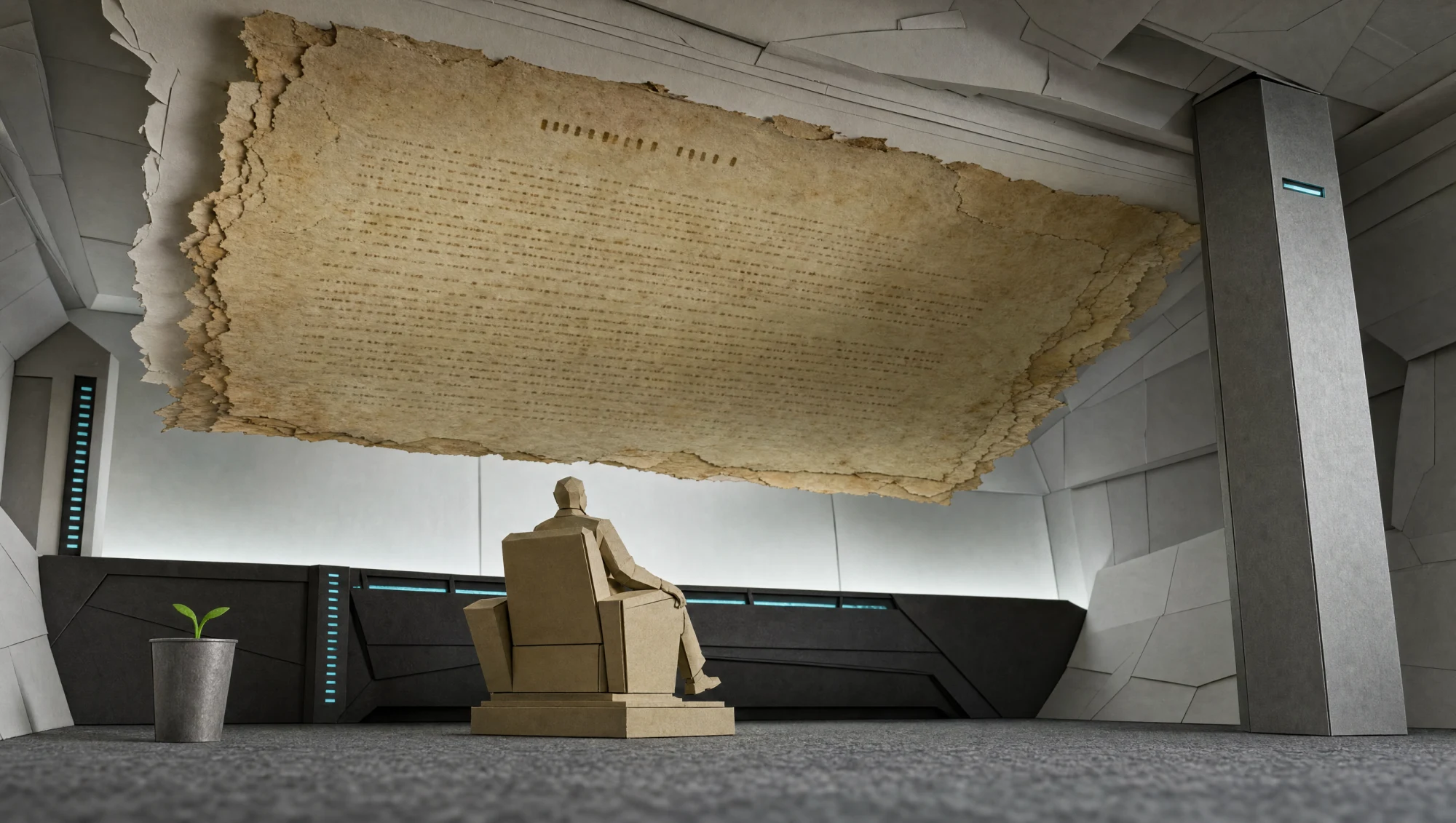
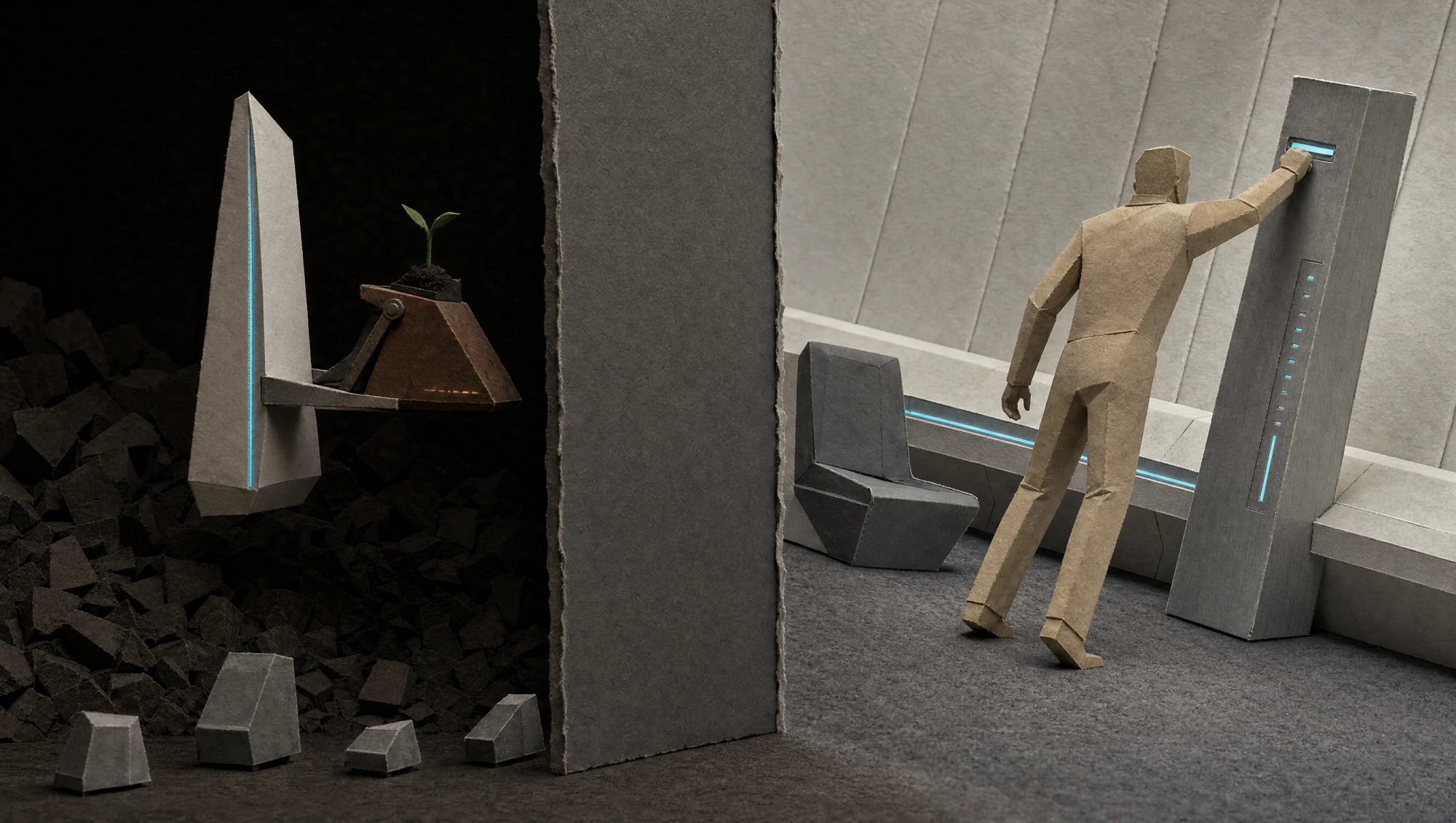
The captain never learned the job the ship already did. A job a machine does well is a job fewer people learn to do.
About 12 minutesWALL-E, 2008
Interactive visual story
The chair
Scroll to change the camera, not the story. It opens at ground level on an emptied planet, sits down in the chair on the bridge for two beats, rises out of it once, at the midpoint, when an order older than everyone aboard comes into view, stands for the take-over, returns to the ground at the closest distance in the set, and ends on the same working surface it started the ship on.
Scroll, or use the step controls, to move the camera through eight beats.
The directive that grew
01
He has done one job for seven hundred years.
Long enough to grow a self inside it.
WALL-E is the last working cleanup robot on a garbage-covered Earth, running on parts taken from the ones that stopped. He still compacts trash. Along the way he has grown a collection and a preference: bolts, a lighter, a videocassette of an old musical whose dancers he tries to copy, and a living plant he tends in an old shoe. The directive is intact. Something else grew inside it.
02
The captain works a console that only ever talks back.
He runs the morning report, and the answer for every system on the ship is the same single word.
On the flagship of the fleet that carried Earth's people away, humans have lived for seven centuries under an autopilot that handles every task. Their bodies have thinned from microgravity and inactivity across that time, which is the cause the film gives. The captain is the ship's human pilot, the latest of a line of them, with little to do but send cheerful messages. Each morning he runs a status report and the answer for every system is the same single word. The announcement is the one thing he says he gets to do on this ship. The plot begins because he notices a flashing button on his own console and has to ask the autopilot what it is.
03
He waits for the autopilot to leave, then asks one more question.
The first time he goes around the machine it costs him nothing. It is the same act the last act makes expensive.
A clump of Earth dirt ends up on the bridge floor. The captain has the ship's computer analyze it, then asks the computer what earth is, and what a sea is. That night he asks what a hoedown is and tells the autopilot that Earth is amazing, and the autopilot shuts his screen off and wishes him good night. He waits for the autopilot to go, then whispers to the computer for one more word. Two machines are in that room, and he has just found out he can reach one around the other. Earlier that day an operations manual had come out of the console with a recording, and he read the word on its cover as a person's name and spoke to it. He is not incurious. Nothing aboard had ever required him to know.
04
The order was addressed to the machines, not to the crew.
The machine is not wrong about what it was told. It is wrong about the year.
The probe brings the plant to the bridge. Fascinated by what he has been learning, the captain plays her recording of the mission and sees that the planet is still wrecked; watching the same recording, the probe sees how WALL-E cared for her while she was shut down. He says they have to go back, and orders the plant into the holo-detector. The autopilot answers that it is not necessary, then that the reason is classified, and the captain objects that a secret cannot be kept from the captain. He makes it an order, and the machine obeys: a second recording, in which the company's chief executive tells the autopilots to keep the ships in space indefinitely because the cleanup failed. The captain asks when the message was sent. Nearly seven hundred years ago. He argues that things have changed and that the green living plant in front of him is the proof. The ship had carried a procedure for deciding exactly that. One machine, holding a later order, could refuse to run it.
05
In the trash, the probe sets her own directive aside.
Not for the captain's plot. For the machine that looked after her while she was shut down.
The machine will not take a new order. It demands the plant, WALL-E keeps hold of it, and in the struggle the machine shocks him, shuts the captain in his quarters, and drops both robots down the garbage chute, where compactor arms close on them with the trash. The probe frees them. When WALL-E, barely working, shows her the plant he has rescued a second time, she sets her own directive aside to save him, searches the trash for parts, and decides his survival depends on going home. A small cleaning robot wedges the trash doors so the two are not swept into space, and the ship's freed malfunctioning robots rally behind the three of them against the security robots. From confinement the captain broadcasts an order to take the plant to the holo-detector, and it is knocked out of the probe's hands before she can place it. WALL-E jams himself into the holo-detector to hold it open. Both of the captain's orders about the plant have now failed.
06
He gets to his feet and takes the ship off the autopilot.
The switch takes no skill. It takes the authority he had never once used.
The captain tricks the machine into meeting him on the bridge and fights it hand to hand. The ship tilts, the passengers slide, and every screen aboard carries the fight. In the holo-detector the machine closes on WALL-E, who is holding it open. On the bridge the captain gets to his feet, walks for the first time in his life, and turns the machine's switch off, relieving it of duty. Watching him win, the passengers and the robots turn on the security robots together and pass the plant to the probe, who places it. The ship's computer verifies where the plant came from and sets its own course for Earth. The take-over is one hand on one switch. What it changes is who is allowed to decide, not what the man can do.
07
The first thing he does on the ground is hand out the work.
It is not his first order. The two he gave about the plant were both refused, and other hands carried it.
The ship lands and the captain tells the people what restoring the planet is going to ask of them, which is the first work any of them has been handed in seven centuries. It is not his first order: he ordered the plant to the holo-detector from the bridge and again from confinement, and neither order carried. The plant was moved by a probe, a crushed cleanup robot, a small cleaning robot, and a crowd of passengers who had never done anything together. The end credits carry an epilogue, added because several of the director's colleagues doubted these people could last a couple of weeks on a planet, showing them working out with the robots' help how to grow food, make fire, find water, and build.
08
Reliable automation does not have to fail to leave you holding a job you never learned.
Name the part of your work the tool now always does, and do one instance of it yourself this week, on purpose.
The record separates three things that usually get blended. Operators supervising reliable automation notice its failures less often, in novices and experts alike. Trained people lose skills they stop practicing: the FAA told airlines in 2013 that continuous autoflight does not reinforce manual flying and asked operators to schedule hand-flying, and in four Polish endoscopy centers nineteen experienced doctors' unaided detection rate fell from 28.4 percent to 22.4 percent after AI assistance arrived, in an observational study. The captain is the third case and the narrowest: a person who learns the job with the tool already doing it. One small first-party randomized study measures it. Fifty-two mostly junior developers learning an unfamiliar library scored 50 percent on a comprehension quiz with an assistant against 67 percent without one, with the widest gap on debugging and no significant time saving. The film's obstacle, a machine that refuses to be overruled, is in none of that: the mutiny is fiction. What is left is the part you can still check on yourself, which is whether you could do the work by hand if you had to.
What this means today
Ask what you could still do without it.
Reliable automation does not have to fail, resist, or mean anything to leave a person holding authority they cannot exercise. Three findings sit under that sentence and they are not one mechanism: attention while the machine runs, a skill once held and then stopped, and a skill never built. The captain is the third, and it is the narrowest of the three. The claim is about the job and not the body: the film gives its own cause for the passengers' condition, microgravity and inactivity over seven centuries, and nothing here reads a body as a record of skill.
What are you still watching for?
In a 1993 flight-simulation experiment, detection of automation failures fell to about a third when the automation was constantly reliable, against about four fifths when its reliability varied. A 2010 review in Human Factors found the effect in novices and experts alike and concluded it cannot be overcome by simple practice or prevented by training or instructions alone. The more reliable the tool, the less your attention is actually on it, and trying harder is not the fix.
What have you stopped doing by hand?
The FAA told airlines in January 2013 that continuous use of autoflight does not reinforce manual flying skill and could degrade a pilot's ability to recover the aircraft from an undesired state. In four Polish endoscopy centers, nineteen experienced doctors' detection rate in colonoscopies performed without AI fell from 28.4 percent to 22.4 percent after AI assistance was introduced; that study is retrospective and observational, in one country. This is decay in people who already had the skill, which is not the captain's case.
What did you never learn, because the tool was already doing it?
This is the captain's case and the narrowest claim on this page. In a randomized study of 52 mostly junior developers learning an unfamiliar library, the assisted group scored 50 percent on a comprehension quiz against 67 percent for those who wrote it by hand, with the widest gap on debugging questions and no significant time saving. It is small, first-party, and measured shortly after the task, and it is the only study here that measures a skill that was never acquired rather than one that faded.
When did you last practice on purpose?
The only remedy anyone in this evidence has actually written down is scheduled practice, not harder watching: the FAA asked operators to create deliberate opportunities to hand-fly. The same learner study points the same way from the other end, since participants who used the assistant to ask conceptual questions retained more than those who handed over the whole task. Delegation is not the variable. Whether you ever do it yourself is.
WALL-E showed machines taking over. The captain never learned the job the ship already did. A job a machine does well is a job fewer people learn to do.
Sources and boundaries
The film carries the story. Three findings carry the present, held apart, with their limits attached.
Four records for the film and its makers, one counterreading of its bodies, and seven sources for the present: two on monitoring reliable automation, three on skill decay in trained people, one structural argument from 1983, and the one small first-party study that measures a skill never acquired.
AFI Catalog · Pivotal sequence of record: the last working cleanup robot and its collection, the passengers' bone loss and its stated cause, the captain's reduced role, both recordings, the order to the autopilots, the veto, the chute and the compactor, the probe setting her directive aside, the stand and the switch, the humans passing the plant, the landing, and the credits epilogue
springfieldspringfield.co.uk · Release-verified beats the synopsis omits: the status report answered with one word for every system, the announcement he calls the one thing he gets to do, the flashing button he has to ask about, the word lookups and which machine answers each, the misread operations manual, the secrecy exchange that forces the reveal, the year the message was sent, and the relief of duty
Library of Congress · The film's recognized center as an ecological cautionary tale and a robot love story, which is the strongest reading this treatment builds beside rather than replaces
International Journal of Aviation Psychology, Parasuraman, Molloy and Singh, 1993 · Monitoring complacency: detection of automation failures under constant against variable reliability, in a 40-participant simulator study
Human Factors, Parasuraman and Manzey, 2010 · Complacency and automation bias in novices and experts alike, not overcome by simple practice or prevented by training or instructions. A finding about attention while the automation runs, not about skill
Automatica, Lisanne Bainbridge, 1983 · The structural argument that automating the routine work leaves the operator least practiced at the rare intervention
Federal Aviation Administration, 4 January 2013 · The regulator's written warning that continuous autoflight does not reinforce manual flying skill, and the one remedy the record actually carries: deliberate hand-flying opportunities
US Department of Transportation, Office of Inspector General, AV-2016-013 · The perception gap in trained people, with its own limits: an estimate of 90 percent automation use with no industry-wide data behind it, and a 30-pilot figure reported secondhand
The Lancet Gastroenterology and Hepatology, 2025 · The first clinical deskilling signal: nineteen experienced endoscopists across four centers, a 6 point absolute fall in unaided detection, retrospective and observational, in one country
Anthropic, 29 January 2026 · The one study of non-formation in learners, which is the captain's case and the deck's claim. Small, first-party, and measured shortly after the task, and the page says so wherever it is used
Slate, Daniel Engber, 10 July 2008 · The strongest counterreading of the film's bodies, which this treatment answers by naming the in-film cause, keeping the claim on the job rather than the body, and drawing no passenger at all
How this story was made and checked
Film check
Plot checked 2026-09-04 against the AFI Catalog full synopsis and history tabs and the release dialogue transcript, in targeted passes across three revision rounds, with the beat order and the causal chain corrected against both. No line of dialogue is quoted. Every beat carried by the 2008 shooting draft alone is excluded pending condition 8, and the three places where the draft would add a causal clause are named in the beat notes rather than asserted on the page.
Original art
All visuals are project-generated concept illustrations made from text prompts with no film images as references. They reproduce no film frame, performer likeness, voice, dialogue, score, logo, title treatment, set, prop, vehicle, or shot. The animated character designs are the main risk this title carries, so the boards deliberately draw none of them: the cleanup robot is a low rounded wedge of scuffed rust plate with one horizontal amber band, no eyes, no head, no treads, and no cube body, and the probe is a flat-sided blade of cool white with one thin cyan seam, no visor, no face, and no egg or capsule body, so neither silhouette is recognizable as the film's. The ship's automation has no body at all: a lit console band, a status column, an after-hours glow, and one small lit slot high on a plain brushed-metal column that is never wheel-shaped or ring-shaped, never a face, and never a red lamp. Red appears nowhere in the set at any strength. No board carries text of any kind, no board renders a human face, no passenger appears anywhere, and no board reads a body as a record of skill. The seedling is never drawn in a shoe or a boot, and the company's chief executive, a live-action performance, is staged only as a dated document and never as a person. The three machine forms are symbolic editorial embodiments, not the film's designs and not a claim that any current system has a body, a presence, an inner life, or an aim.