
Practical Edge
AI Drive-Thru Ordering: How to Plan for Human Handoffs
AI ordering can move the queue faster, but someone still handles the exceptions. Learn how to plan takeovers, estimate crew workload, and test the complete service.
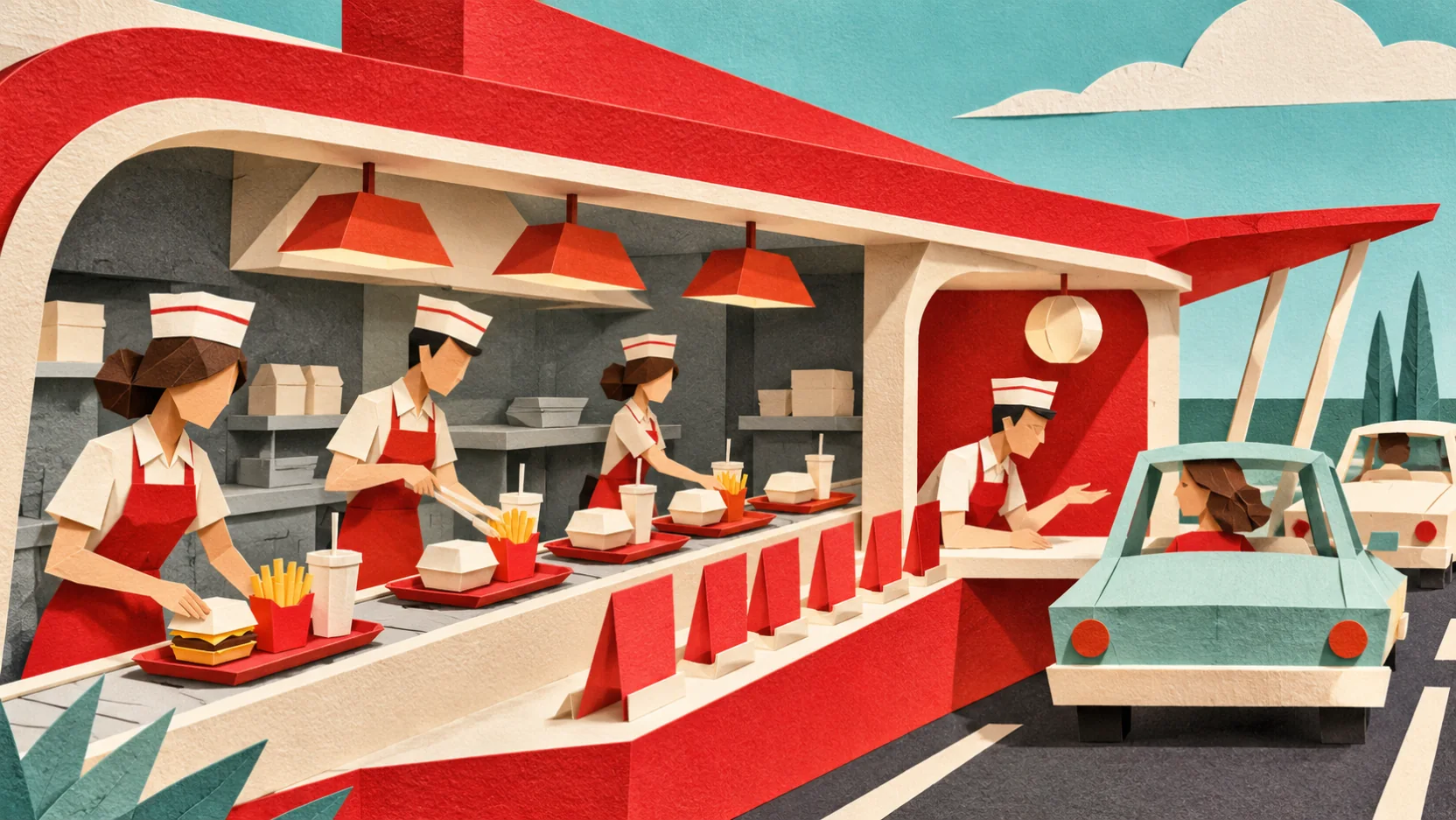



The lunch queue is growing. An automated order taker handles the next customer, who changes a drink, corrects an item, and asks for a person. A crew member steps in while the kitchen keeps working. For the manager, that transfer is part of the service they have to staff.
If you are considering AI ordering, the useful question is how much work reaches the crew and whether they can pick it up with the customer's request intact. This article shows how to define the handoff, estimate its workload, and compare the complete service with the way orders are handled today.
Wendy's FreshAI pilot provides a documented case to examine. We separate its reported intervention rate from the service outcomes an operator would still need to measure. The connection to Superalignment's research is practical: checking whether delegated work meets the intention behind it. It also guides Praxis, which we are developing to help teams define the rules, checks, and human decisions around AI workflows.
01 / Practical Edge
What did Wendy's FreshAI pilot actually measure?
Wendy's reported that its 2023 FreshAI pilot handled 86% of drive-thru orders without crew intervention across four Columbus, Ohio restaurants. Restaurant Dive's December 2023 account also described a nearly 99% rate for orders submitted to the point-of-sale system, including orders a person helped correct, and one test site's 22-second service-time advantage over the Columbus market average. These are different measures. [1][3]
By May 2, 2025, Restaurant Dive reported deployment at more than 160 restaurants and a target of more than 500 by year-end. [2] Its earlier coverage also reported that about 70% of orders using another provider, Presto, required human intervention. That is a separate provider's historical figure, not a Wendy's result or a current industry average. [3] Neither an order submitted with human help nor an order completed without intervention tells you how many meals needed a correction at pickup.
For your own evaluation, keep separate counts for orders attempted, human takeovers, customer corrections, and remade meals. A single success percentage hides which part of the service actually improved.
02 / Practical Edge
How should an AI drive-thru hand an order to a person?
An AI drive-thru handoff should preserve the current order, unresolved request, and route to a crew member. The assistant can gather items and modifiers, present a confirmation, and return an intelligible record when a crew member takes over. The person should see both the current order and the unresolved question.
We would test that record with a late correction: change the size after adding a second meal. Can the crew identify which item changed without replaying the entire conversation? If not, the assistant has shifted clerical work into the busiest moment.
The restaurant manager owns the takeover procedure. A technology team can maintain the model and integration, but a shift needs a named person who can pause voice ordering and restore the ordinary ordering path. These are proposed controls for a pilot, not claims about Wendy's internal configuration.
03 / Practical Edge
How much human takeover capacity do you need?
Use the calculator to translate an intervention rate into crew minutes. The default 14% is the arithmetic complement of the historical pilot's 86%. The order volume and handling time are illustrative inputs, and actual takeovers may require very different amounts of work.
An hourly average also hides bursts. Repeat the calculation for the busiest interval your restaurant actually experiences. If the same employee must pack meals and resolve every voice exception, record the collision rather than allocating that person's full capacity to both jobs.
This arithmetic estimates one workload component. It cannot establish a staffing reduction, predict customer satisfaction, or tell you whether the orders that avoided intervention were correct.
04 / Practical Edge
How do you test AI ordering during a real shift?
Choose a narrow ordering window and keep the familiar ordering path available. Before starting, define which request types require an immediate person and how a customer asks for one. Include background noise, a correction, an unavailable item, and a request the assistant cannot settle.
Compare similar shifts using total crew time, queue time, customer corrections, and completed orders. Track the time spent cleaning up order records as well as time spent talking. Assign the shift manager to review takeovers and authorize changes to the scope.
Keep a small sample of completed orders for a separate check. Reviewing only escalations would tell you how the system handles known difficulty while leaving its apparently ordinary work unexamined. Retain only records permitted by the restaurant's existing privacy practices.
05 / Practical Edge
When should you expand an AI drive-thru pilot?
A reasonable objection is that familiar human ordering also has mistakes, training costs, and queues. The comparison should therefore use your existing service as the baseline. Demanding perfection from one path and measuring only speed in the other would settle little.
Automating drive-thru ordering only succeeds when crew handoffs are as dependable as the voice model. If field trials demonstrate that exception packets increase ticket resolution times without reducing order remakes, that is clear evidence to pull back. Start with a bounded pilot on peak-volume shifts, measure takeover duration alongside kitchen errors, and expand only where crew intervention stays manageable.
Expand only the request types for which the measured service improves. The next useful result may be a quieter takeover, a smaller queue, or fewer corrections. Which of those outcomes would make your busiest shift easier to run?
The lesson for Praxis starts at the takeover point. Superalignment is developing Praxis to help teams build their own harness: the workflow steps, information, rules, checks, and human approval points around AI. For an ordering workflow, the design questions would include which requests AI may handle, what makes it stop, and what the crew receives. These are requirements to establish and test, rather than evidence that Praxis runs this restaurant system.
If your own service queue has a routine path and an exception desk, start by describing what must survive the transfer. Explore how we are developing Praxis around work like that.
What does Wendy's 86% FreshAI figure mean?
It is the operator-reported share of orders handled without crew intervention in the 2023 pilot. It is not a current chainwide result or a measure of error-free meals.
How do you estimate AI drive-thru handoff workload?
Multiply orders per hour by the intervention share and minutes per intervention. Add monitoring and other crew duties separately, and test peak intervals rather than relying only on hourly averages.
Sources, dates, and what they establish
Researched November 17, 2026. Public-source verification only. We have not interviewed these teams, accessed their systems, or audited their performance. Proposed checks and all widget scenarios are Aligned editorial work.
- Wendy's pilot update
2023-12-11 · Operator primary record
Supports: 86% without intervention; four Columbus restaurants; crew role. Limit: Historical pilot, self-reported; no independent meal-accuracy audit.
- Restaurant Dive coverage
2025-05-02 · Outside trade reporting
Supports: 160+ restaurant deployment and a 500-plus year-end target. Limit: Trade coverage of operator updates; not an independent controlled trial.
- Restaurant Dive historical pilot comparison
2023-12-11 · Outside trade reporting
Supports: Definitions of the 86% and nearly 99% measures, one-site speed comparison, and separate Presto intervention figure. Limit: Historical operator claims and a different provider; not current industry benchmarks.